Month: February 2025

Early College Options for Sutton Students

Early College Options for Sutton Students

Early College Options in High School

The cost of college is increasingly becoming too much of a burden for students to bear. In order to help students succeed many High Schools in Massachusetts have partnered with state and community colleges to offer dual enrollment programs. The Commonwealth Dual Enrollment Partnership (CDEP) allows high school students to take college level courses at low to NO cost – and the best part is students receive credit in high school AND college level course credits. These programs have existed and expanded since 2017.

Students in Sutton should be aware of this program and the opportunities it affords with the many colleges (private or community) in the area or, with the Commonwealth Collegiate Academy, any of the UMass System universities. In FY25 the commonwealth provided funding of about $5 million dollars for these partnership programs through a program called CDEP. This funding helps cover the costs to the district for textbooks and transportation. In my research I’ve noticed a few schools in the area offer this specifically as a dual enrollment option.

I believe that early college partnerships like this are critical to helping our Sutton High School students succeed and might be able to fill some of the gaps in programing that we might not be able to offer.

https://www.doe.mass.edu/ccte/pathways/early-college/default.html or
https://cca.massachusetts.edu

Enrollment Issues

Enrollment Issues

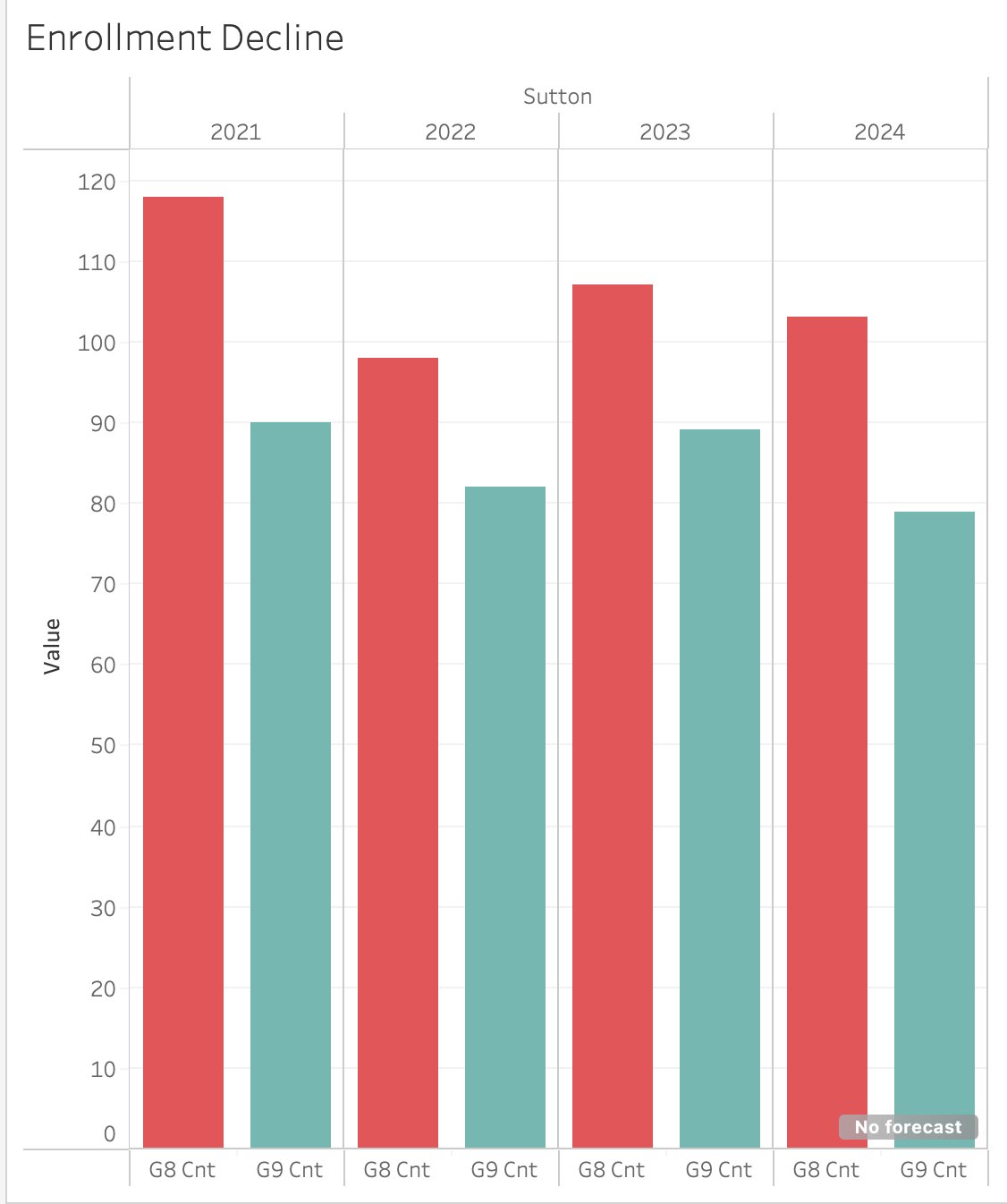
 In looking at the enrollment data from the Massachusetts Education to Career research and data hub I noticed something interesting. To the right is our district enrollment our enrollment from 1994-2024, which I graphed from the following dataset. Enrollment at a high level seems relatively stable, however when we look at enrollment between Middle School and High School there’s a decline. Below is a bar chart I put together visualizing this data.

Here is a cross tabulation showing the actual numbers with grade 8 and grade 9:

The School Committee needs to understand why there is a decline? Are course offerings not up to par with neighboring schools like BVT?

If so can we shift resources to offer desired courses? Is something else going on that is not easily measurable?

Because enrollment is a component of our Chapter 70 funding, we should be spending some time trying to understand why we loose students from 8th to 9th grade, not simply being content with loosing students. If I am elected to the school committee I’ll work with administrators to help retain students in our High School.

As an update (3/5/25), I see that the school has just sent out a survey posting asking for enrollment intentions for students for the upcoming school year – this is a great common sense suggestion and it’s awesome to see it in place!

Focusing on our Core

Focusing on our Core

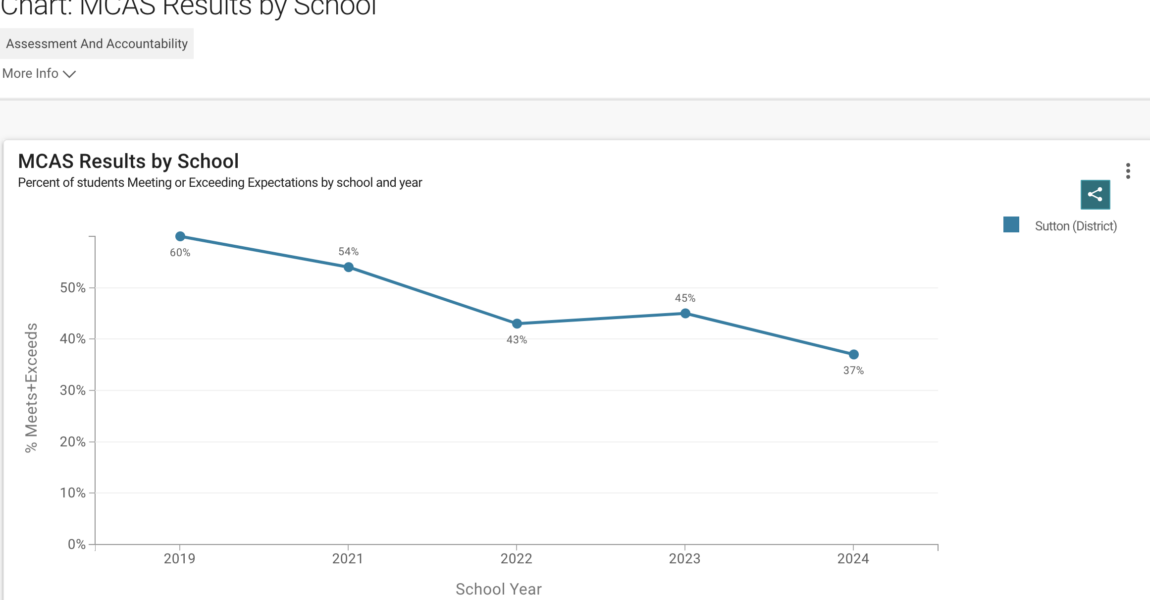
Sutton needs to focus on its core Math/English/Science needs. With underperformance as a District on our MCAS for Math/English/Science our system needs to make tough choices about where we are focusing our valuable educational resources. The school and school committee need to take a look at our course offerings and help refocus the curriculum to create opportunities where our students can succeed in these critical areas. Where there are resource gaps we need to partner with organizations and institutions to create pathways for our students to excel in these areas.

Source (https://educationtocareer.data.mass.gov/stories/s/MCAS-Data-Trends/qagd-r9iy)

Common Sense?

Common Sense?

Please note that this is actual material from a homework assignment in the Sutton Schools. I write this as an example of where we need some common sense in our school systems. It remains unclear to me how this lesson gives our kids critical thinking skills or equips them to be independent thinkers and learners in the 21st century.

Children need to be equipped with the skills to search out and learn for themselves. They need to be taught how to learn and not simply what to learn. I was somewhat concerned when I read an article for an english class and came across this excerpt from the book:

The context of this was around diversity and stereotypes with the author making the point “When diversity is not valued, or when people are not allowed to share their own point of view, stereotypes show up instead.” To be clear I believe diversity is very important, but I object to the limited nature of Diversity portrayed in this excerpt. Notice that all the examples are based on a gender, ethnic or disability scenario. The clincher from the author goes on “Another way to challenge stereotypes is to care about representation. That means making sure that all perspectives get shared and people get to tell their own stories, especially people who haven’t had those opportunities in the past.”

As a parent I don’t see any evidence of the other side; rather there’s a single focus on reducing diversity to a simple equation “If you think this way, you are making a stereotype, stereotypes are bad, therefore you are bad.”

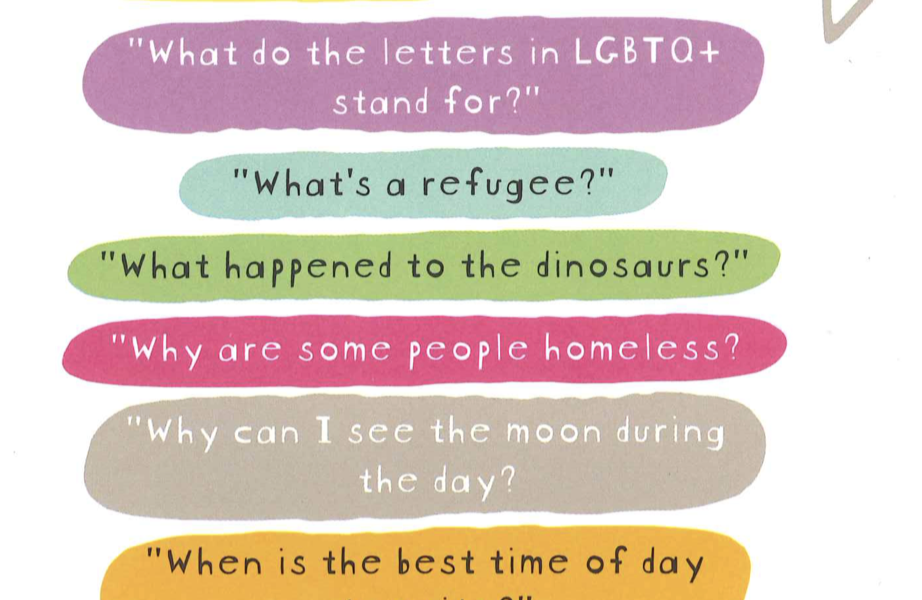
Going further kids are introduced to questions like this

As a parent, I encourage questions however I find the authors singular focus somewhat disturbing: “What’s ASMR?”, “What’s a refugee?”, “What do the letters in LGBTQ+ stand for?” Again I see diversity being reduced here from diversity of thought to a focus on certain subjects that, rather than tilting to the center, shift left. I highlight these examples to show that our kids are being fed material that encourages them to think a certain way rather than teaching them how to think.

As a parent, I would have loved to see some antithetical points – so for example an antithetical point to the question of “what is a refugee?” might be a countervailing question like “what are some challenges posed by mass migration?” Bringing an alternative thesis, even difficult ones help kids arrive at their own thoughts and help in the critical thinking process. It also helps provide a framework for people to think about all sides of an issue.

As a parent and if elected to the school committee I want to make sure all viewpoints are represented.

In hindsight and in thinking about this particular lesson common sense would dictate that it might have been better to present a lesson with less charged questions…

Fiscal Responsibilty

Fiscal Responsibilty

Our school is facing some tough financial situations both now and in the future. As a committee we need to scrutinize every aspect of the budget and make sure it’s focused on our core mission of education. As a member of the school committee I pledge to bring common sense fiscally responsible solutions. Here are two examples I’ve identified in the FY26 budget:

  • Software Licensing & Subscriptions: Includes Google Workspace, Microsoft Office, and various specialized education software.
  • Hardware Costs: Computers, tablets, network equipment, and IT infrastructure.

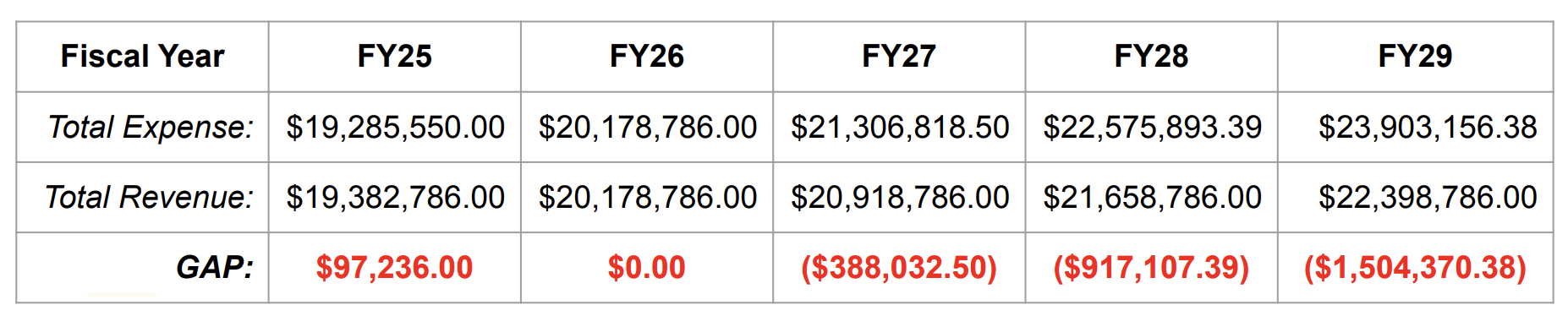
Given that the school uses Google for students, we should look to consolidate and remove any charges for Microsoft Office (~$9,500) if possible. Hardware costs should be minimized – for example are teachers using chromebooks or full laptops? We are also sharing some IT services with the town, is it possible to consolidate and share more of these services in the future? Before eliminating sports programs we should look to as many areas of cost savings as possible. As you can see from the chart provided in the FY26 Preliminary Budget Presentation we are facing an increasing GAP into FY29.

If elected to the committee I promise to bring common sense, financially responsible solutions to control costs and ideas to increase revenue, while keeping the best interest of the taxpayer in mind.